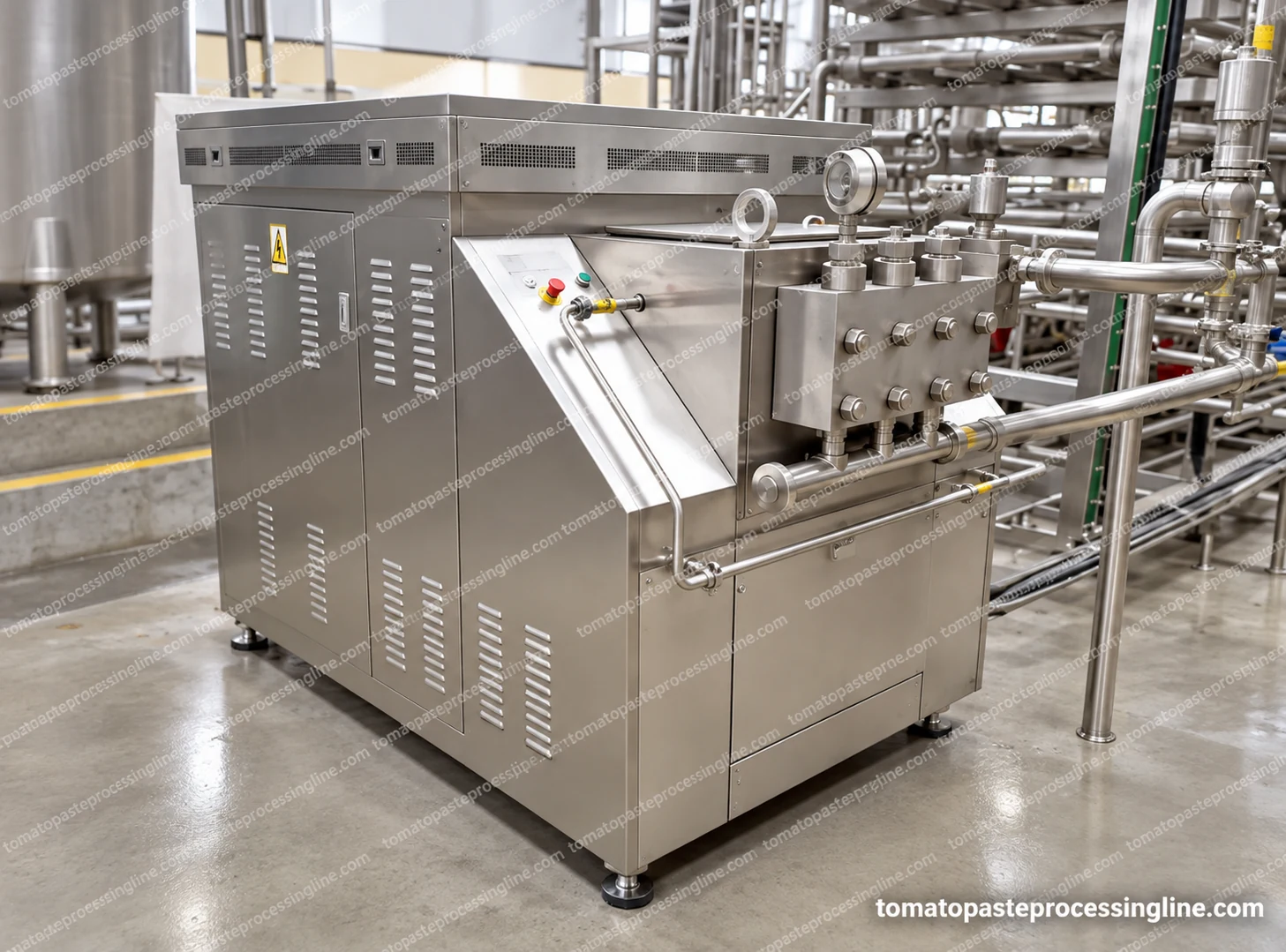
Treat the prepared stream through a selected valve
Product is pressurized and passes through the homogenizing valve region, where the imposed treatment can alter dispersed particles and the product structure. The result depends on formulation and operating condition rather than pressure alone.
This machine is a high-pressure homogenizer. A colloid mill uses a different working arrangement and should be selected as a separate technology when that is the appropriate task; the two names do not describe the same illustrated hardware.
Resolve lumps and ingredient dispersion upstream
The mixing stage should provide a consistent inlet composition and an acceptable particle profile. Large undispersed additions or air pockets can disrupt delivery and make the treatment inconsistent. Define inlet temperature and the pump-feed condition with the selected homogenizer.
Check the recipe after treatment, including viscosity or consistency measured at a defined temperature and sample history. A sauce that deliberately retains pieces may not benefit from the same route as a smooth ketchup.
Set operating conditions from the product trial
| Selection item | Establish | Avoid assuming |
|---|---|---|
| Pressure and flow | Operating point for the actual formulation | A laboratory pressure is an industrial machine rating |
| Inlet particles and viscosity | Suitable passage and feed condition | Every sauce can use the same valve setup |
| Texture measurement | Method, temperature and sample handling | A pressure number alone defines product quality |
| Maintenance and cleaning | Valve, seal and product-path access | A general CIP loop cleans every retained region |
Connect homogenization to the complete finishing route
Consider temperature changes and the product condition leaving the homogenizer when selecting later heating or filling. The hygienic boundary also depends on where this step sits relative to the validated thermal process.
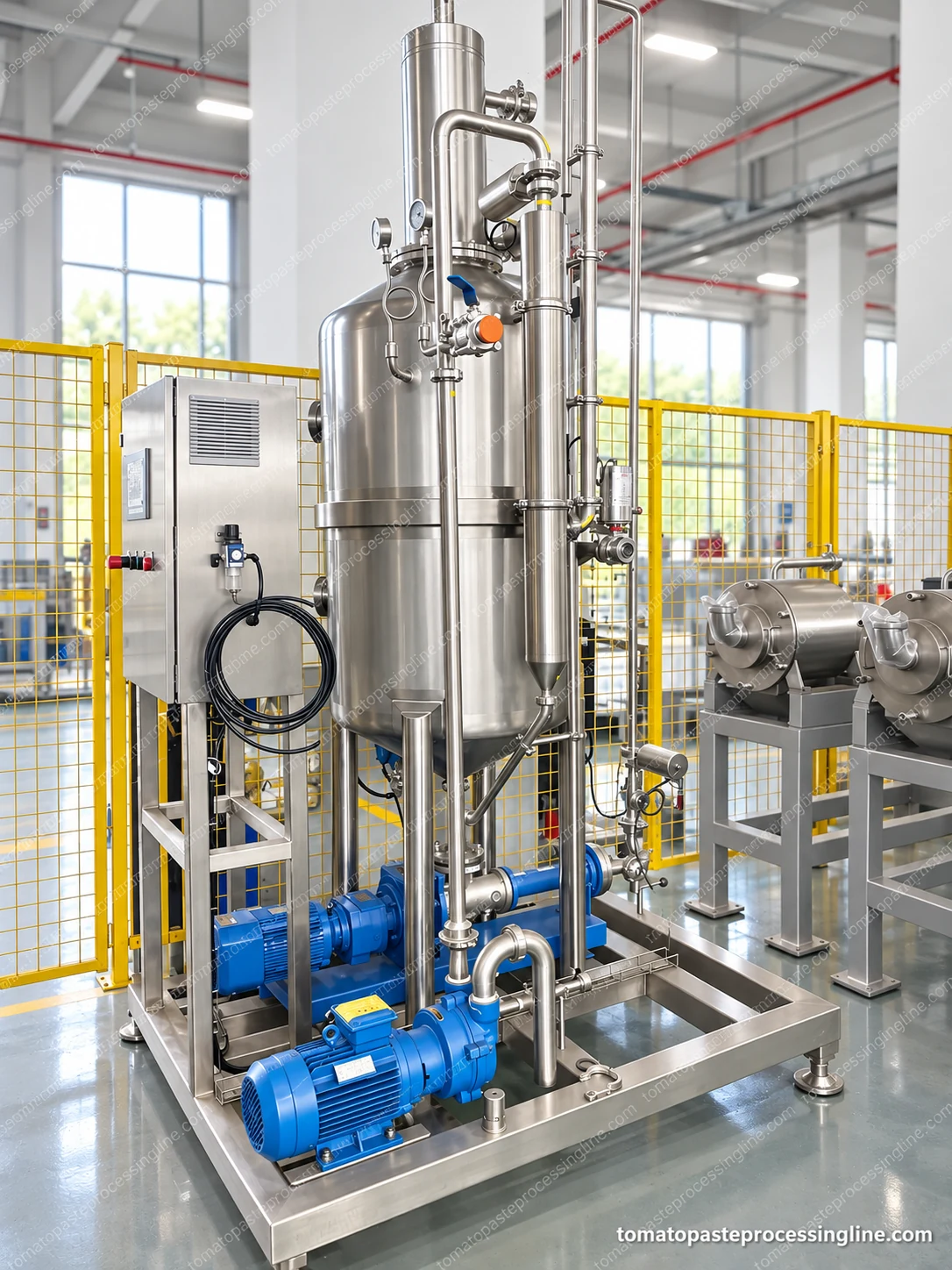
If mixing has introduced air, optional vacuum deaeration can be assessed as a different duty. It does not replace appropriate inlet feeding, nor does it make an unsuitable formulation suitable for homogenization.
Further detail
Questions about this equipment and process
Is higher pressure always better for ketchup?
No. Select and assess the treatment using the actual formulation and desired texture. The trial should show the product response at the proposed operating condition.
Does homogenization replace final thermal processing?
No. Texture treatment and product preservation are different functions. Their order and connection depend on the validated product and package route.