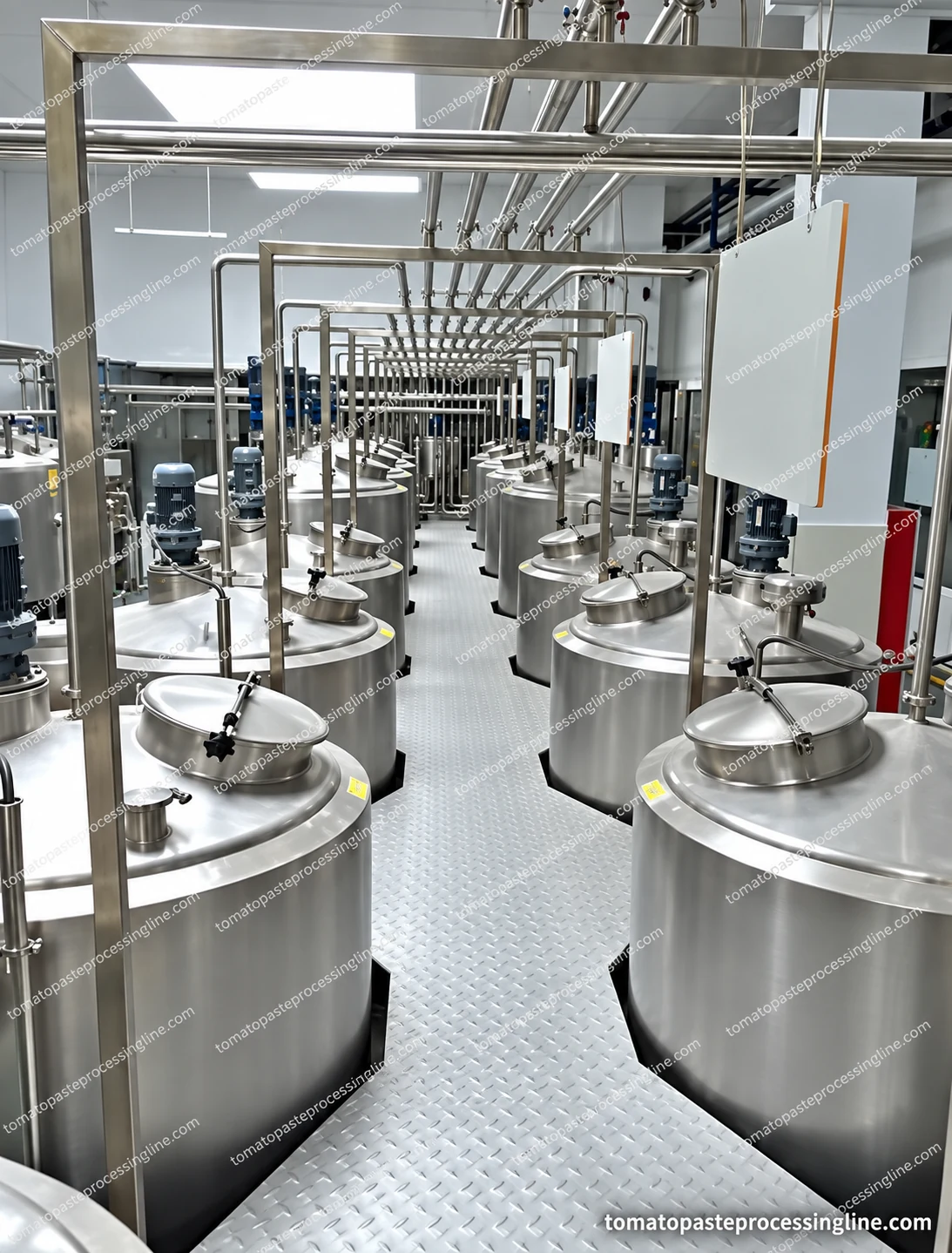
Build a controllable batch from the paste base
The incoming paste concentration and condition affect how it is unloaded and dispersed. Addition of water, sugar, salt, vinegar, spices or other recipe ingredients changes both the composition and the mixing behaviour. Establish the addition sequence and an observable endpoint for each necessary mixing step.
Ingredient handling and weighing should connect to the batch record. Avoid treating a final °Brix reading as the complete recipe composition when ingredients other than tomato soluble solids contribute to the measurement.
Select the mixing action for the recipe
Top-mounted drives serve the vessels shown. The chosen agitator, working level and speed range need to move the product effectively without leaving unmixed regions or drawing unnecessary air into the batch.
Heating can support selected dissolution or cooking duties, but it must be coordinated with ingredient properties and the later thermal process. Vessel working volume, heating surface and impeller configuration are design selections, not a generic fixed recipe.
Useful mixing-system specification
| Item | Define for the formulation | Why it matters |
|---|---|---|
| Paste receiving | Package, temperature and unloading arrangement | Stable transfer of a viscous base |
| Working batch | Ingredient masses, useful volume and cycle steps | Accurate batch and downstream output calculation |
| Mixing and heating | Required product condition at discharge | Uniformity without unnecessary air or heat exposure |
| Discharge and changeover | Pump duty, residual volume and cleaning route | Consistent batches and predictable product recovery |
Add texture treatment only when it contributes
High-pressure homogenization can be selected for a suitable smooth formulation, while a product intended to retain identifiable pieces needs a different treatment decision. Optional vacuum deaeration addresses entrained air rather than replacing mixing or final thermal treatment.
The Niger can-line example reports dilution, blending and cooking of bulk paste before tubular treatment and packaging. Use the required product and packaging outcome to define the corresponding tank and transfer duty.
Further detail
Questions about this equipment and process
Does this module require a fresh-tomato pulper and evaporator?
No. A purchased-paste formulation route receives an existing concentrate. Fresh-fruit preparation is a different purchasing scope.
Must every sauce pass through homogenization?
No. Texture, particle retention and recipe response determine whether homogenization is useful. Choose it as a formulation-specific step rather than a mandatory machine.