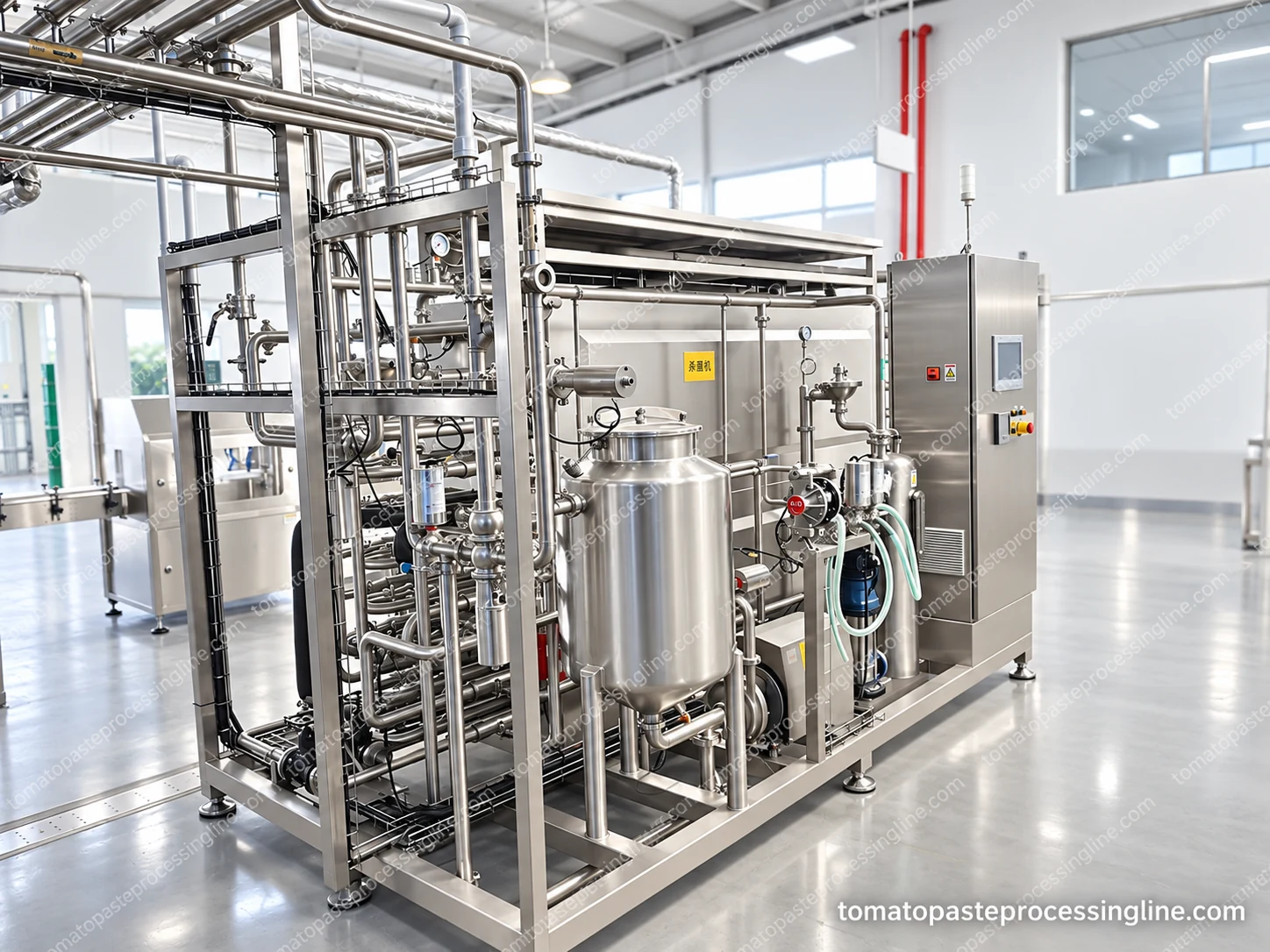
Match the product passage to viscosity and particles
Concentrated paste, screened puree and formulated ketchup do not create the same pressure drop or heat-transfer behaviour. Specify the product condition and maximum accepted particle profile for the selected passage. The product-side pump and the heat exchanger must be assessed together.
The process diagram defines the heating, holding, cooling and product-routing functions. It should identify instruments and vessel connections, including the response to a loss of heating service or an interruption at the filler.
Configuration references, not a production recipe
These values describe the configurable equipment family. The required operating point comes from the actual formulation, flow, package and process validation. It is not selected by applying the same temperature and holding time to every tomato product.
| Parameter | Family reference | Condition to establish |
|---|---|---|
| Temperature | 72–150 °C | Required validated product duty |
| Holding time | 15–120 seconds | Holding geometry and verified product flow |
| Heating and cooling | Hot water or steam; cooling water or chilled service options | Available utilities and required outlet condition |
| Contact material | 304 or 316L options | Product and cleaning exposure, selected seals |
Control residence and temperature together
For a fixed holding arrangement, changing product flow changes residence. The flow measurement, temperature sensing and route for out-of-condition product therefore form one control task. Reducing throughput to suit a filler should not be treated as an unrelated adjustment.
Define the criteria for startup release, interruption recovery and return from cleaning. Records should associate the observed process condition with the production lot; a displayed setpoint alone does not establish that every portion followed the required process.
Separate bulk aseptic filling from retail processing
An aseptic bulk route needs a maintained product boundary through the downstream transfer and filling head. A retail can route instead coordinates the selected filling condition, closure and any postfill treatment with the complete package process. The two interfaces should not share an assumed shelf-life claim.
CIP must reach the selected product circuit, with a defined return and access to seals, valves and serviceable tube connections. Break preheating is an earlier preparation duty and remains distinct from this final product treatment.
Further detail
Questions about this equipment and process
Does the family temperature range guarantee commercial sterility?
No. Equipment range and validated product process are different. The formulation, product flow, thermal history, packaging and hygienic boundary determine the required validation.
Can this be combined with an existing filler?
It can be assessed around the filler’s inlet conditions, interruption behaviour, hygienic interface and control signals. Those connections must be defined before fixing the thermal configuration.