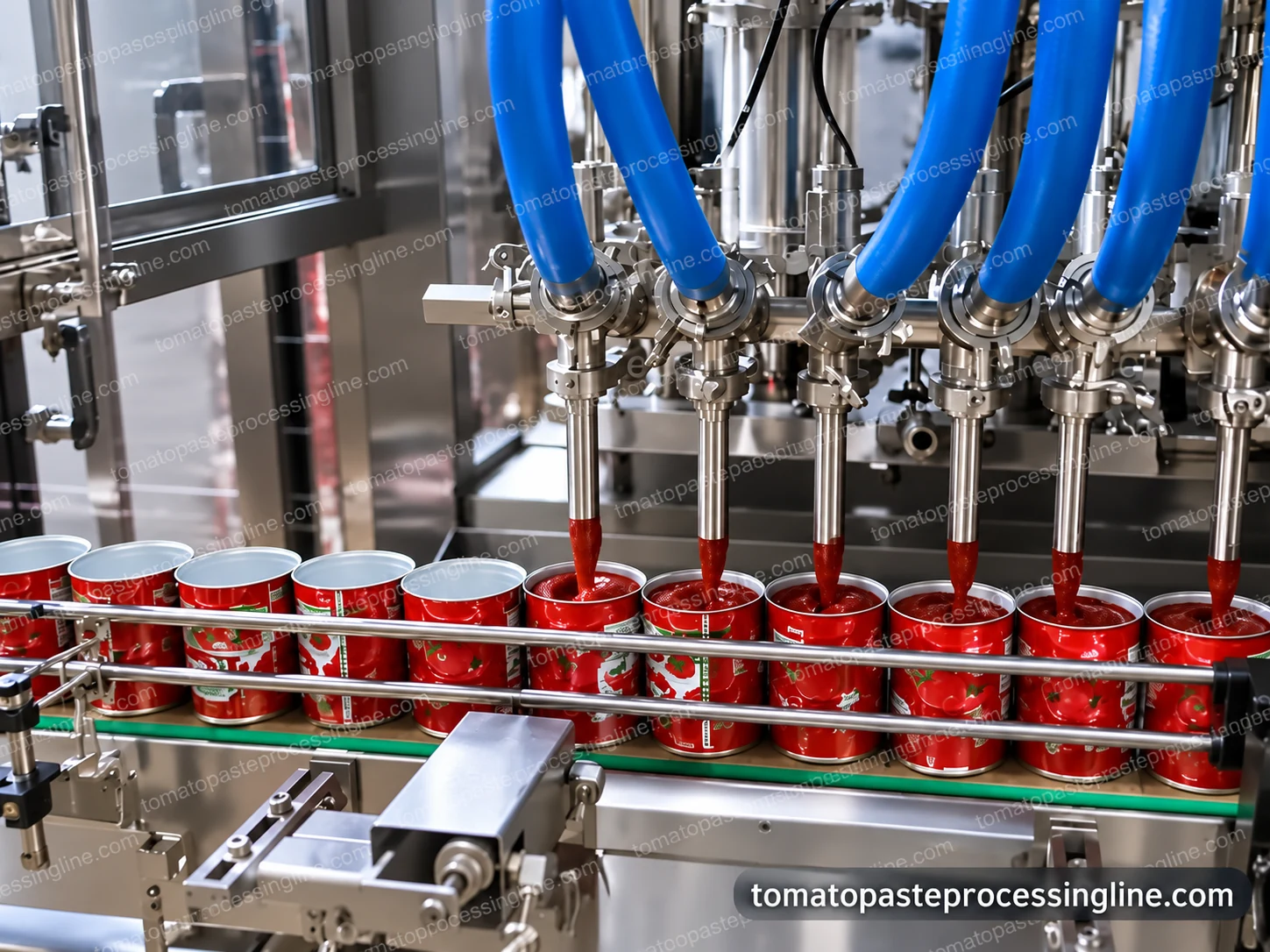
Match nozzle delivery to the can and product
Product hoses feed the nozzles positioned above the conveyor. Can guidance keeps the openings aligned during filling. Select nozzle geometry, dosing control and the fill cycle for the product viscosity, temperature and intended quantity.
Clean cut-off at the end of a dose helps keep the closure area in a suitable condition. Define the fill assessment with the actual product and container; a nominal cans-per-hour value without fill mass does not establish packing output.
A bulk-paste canning application
The reported Niger project supplied in September 2022 reprocessed paste from 200 L and 220 L aseptic bags into 400 g and 2.2 kg cans. Its equipment scope included blending and cooking, tubular treatment, can filling and seaming, followed by spray treatment and cooling.
This is a bought-in paste reprocessing example. Fresh-fruit washing and evaporation were not the purchasing scope. Its sequence connects bulk-paste unloading and recipe preparation to thermal treatment, can filling and the downstream closure and cooling operations.
Specify each downstream interface
| Interface | Information to match | Acceptance focus |
|---|---|---|
| Can feeding and filling | Container dimensions, fill quantity and product condition | Alignment and repeatable quantity |
| Can closure | Compatible end and seam specification | Closure integrity and inspection method |
| Postfill process | Selected package/product thermal and cooling requirements | Recorded process and package condition |
| Handling and packing | Drying, coding and case-handling arrangement | Traceable finished packs without line blockage |
Keep the offered package route explicit
Filling, seaming and postfill treatment are distinct operations. Their selected equipment and controls must work as one sequence, including what happens if the closure station stops. The filling-head photograph illustrates the filling section; closure configuration is specified through its own package and equipment documentation.
Access to nozzles, hoses, valves and the product manifold supports inspection and cleaning. Other retail formats, such as bottles or sachets, require a separately matched filling and closing arrangement. Do not treat a bag-spout filler as a substitute for a sachet forming and sealing machine.
Further detail
Questions about this equipment and process
Is the canning example a complete fresh-tomato paste factory?
No. It begins with concentrated paste in aseptic bags and supplies reprocessing and canning operations. Fresh-tomato extraction and concentration form a different line scope.
Can can-filling equipment establish a universal shelf life?
No. Shelf life depends on the formulation, validated process, closure integrity, package and storage conditions. The filling machine and format alone do not determine it.