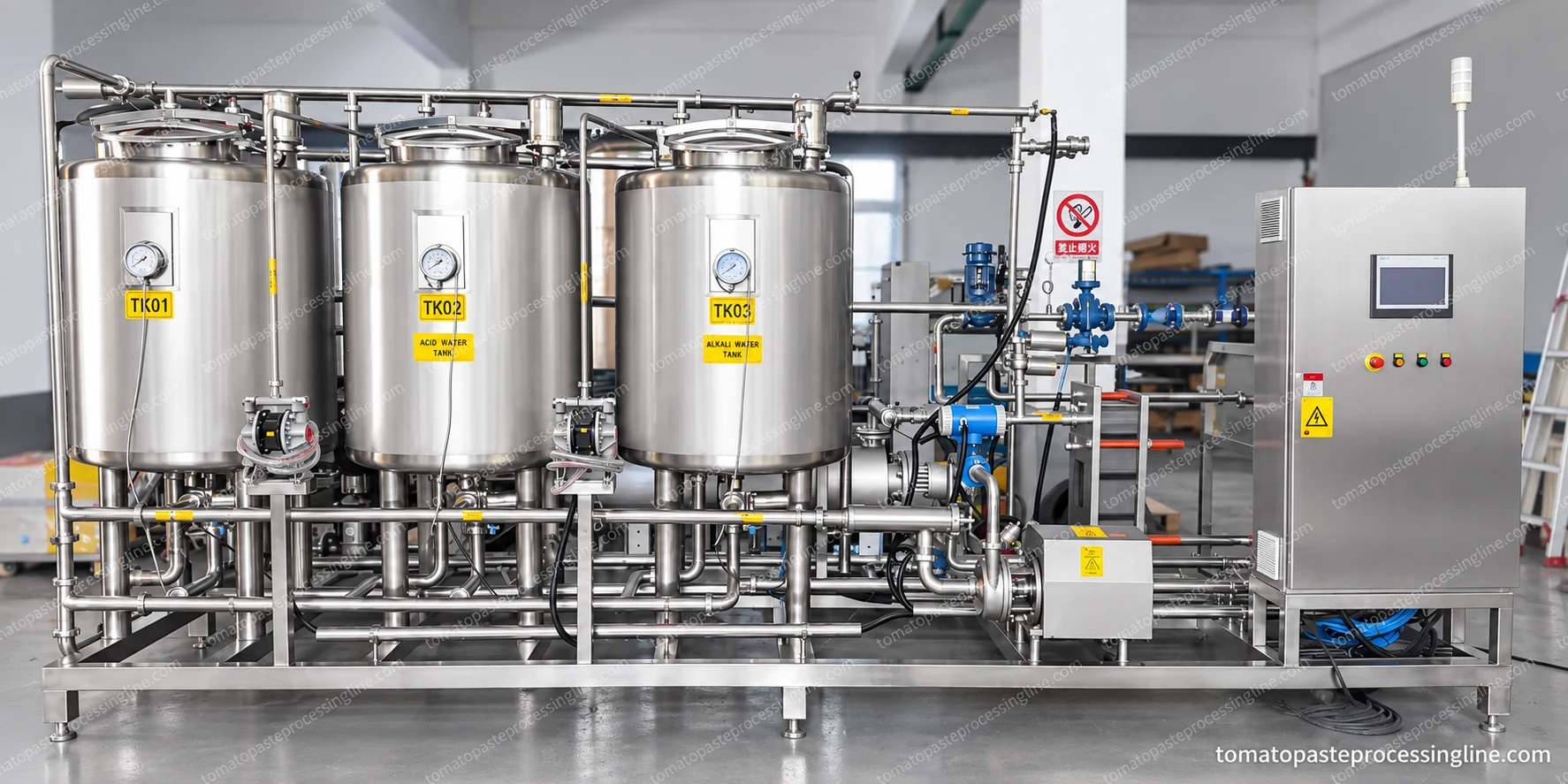
Trace the cleaning path through the product side
Tomato pulp and thick paste can remain in low points, valves and branches after the main flow stops. A cleaning circuit must reach those product-contact regions and drain or return as intended. Start from the actual piping and equipment arrangement rather than a single whole-plant cleaning label.
An evaporator circuit, a mixing vessel and a filling manifold present different return conditions. Identify whether the station serves them sequentially or through separately designed circuits, and size solution volumes and pumping accordingly.
Choose tank functions and heating around the schedule
Water, alkaline cleaning, acid cleaning and recovery are available system functions. They are not a requirement for four physical tanks in every skid. The illustrated configuration has three tanks with gauges, interconnecting pipework and controls.
Heating can be selected from the available steam or electrical service. The required temperature, cleaning media and sequence follow the equipment and product duty; no single chemical recipe or cycle duration is assigned to all tomato operations.
Observe what reaches and leaves the circuit
| Condition | Purpose | Verification point |
|---|---|---|
| Flow and return behaviour | Circulation through the intended surfaces | Selected supply and return measurements |
| Temperature and chemistry | Cleaning condition at the equipment | Appropriate return location and agreed method |
| Draining and final rinse | Removal of spent media and residual chemicals | Circuit-specific endpoint and drain inspection |
| Route changeover | Separation of product and cleaning streams | Valve state and return-to-production checks |
Keep open surfaces and removable parts in the cleaning plan
Tomato conveyors, spray rollers, inspection belts and external residue chutes require accessible cleaning. Crusher covers and knives, pulper screens and selected valve components may also need inspection or removal under their operating instructions.
Those tasks complement closed-circuit CIP. Provide safe access, parts-handling space and a verification method for each zone, including ingredient changeovers on the ketchup route.
Further detail
Questions about this equipment and process
Does the station clean the entire conveyor and washer automatically?
No. The defined closed product circuits connect to CIP. Open rollers, belts and external surfaces need their own accessible cleaning and inspection arrangements.
Can the same program be used for plain pulp and formulated ketchup?
Only if it has been shown suitable for both duties. Ingredients, residue and equipment geometry can require different cleaning and verification conditions.