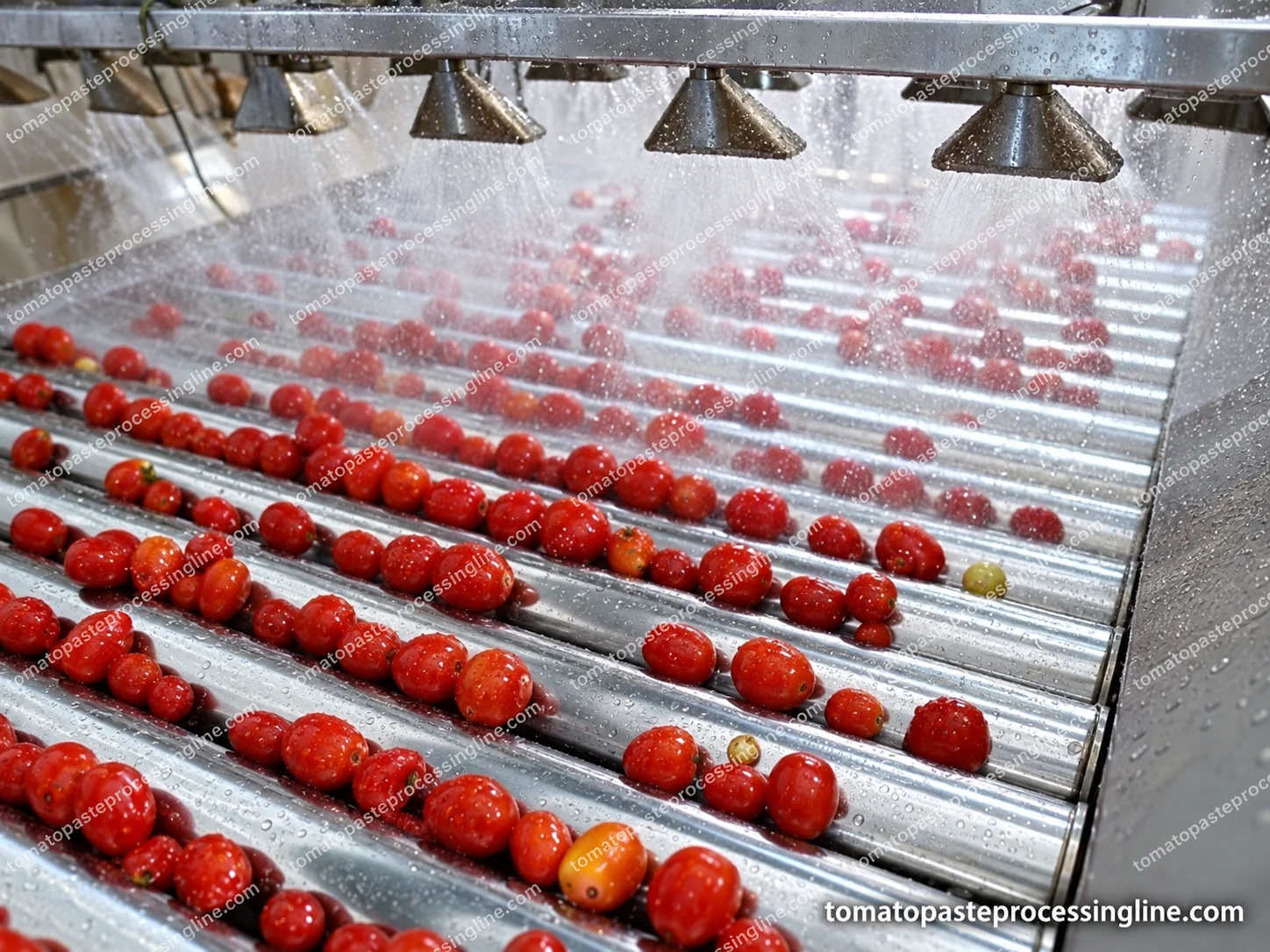
Coordinate fruit presentation and spray coverage
The roller surface creates an open carrying path beneath the spray headers. Uniform loading matters: tomatoes stacked on top of one another shield the lower fruit. The entry chute and conveying rate should spread incoming tomatoes over the useful washing area.
Nozzle position, spray pattern and supply condition determine where the water reaches. Select them around the soil burden and fruit firmness, then inspect both the fruit and the discharged water. Greater spray force is not automatically the right response to poor coverage.
Give solids and wash water their own exit
The wash section needs a defined collection and drainage route for removed soil, damaged fruit material and water. Where recirculation is selected, filtration, replenishment and water-quality control become part of the system scope. A final rinse and a recirculated washing step serve different duties.
Drainage before crushing also affects the product balance. Water carried with the tomatoes should not disappear into an unexplained increase in extracted pulp mass. Arrange the transfer so that fruit reaches inspection or crushing without a large uncontrolled volume of wash water.
Washing-section selection
| Item | Why it changes the arrangement | Useful acceptance observation |
|---|---|---|
| Tomato condition | Firmness and soil burden affect handling intensity | Damage, visible soil and residual debris |
| Loading across rollers | Coverage depends on exposure | No persistent deep pile or hidden lower layer |
| Spray and water supply | Nozzles require a defined operating condition | Coverage remains consistent across the section |
| Water collection | Removed soil must leave the product route | Accessible drains and predictable solids removal |
Treat washing and inspection as connected operations
Washing removes material from fruit surfaces; it does not replace inspection for unsuitable tomatoes. Keep a practical route from the washing discharge to the inspection conveyor, with space for reject handling and access to the roller ends.
Nozzles, roller gaps and the underside need routine access. Cleaning this open section is separate from circulating a CIP solution through an evaporator or thermal skid. The final installation defines the surrounding water collection equipment and accessible covers.
Further detail
Questions about this equipment and process
Does this washing section also grade tomatoes automatically?
No automatic grading or optical rejection is included in the described roller-and-spray arrangement. Inspection and reject handling are separate operations.
Is a full immersion tank required for this arrangement?
The illustrated washing method is spraying over rollers. Any immersion, flotation or additional tank stage is a separate configuration decision based on receiving and cleaning needs.