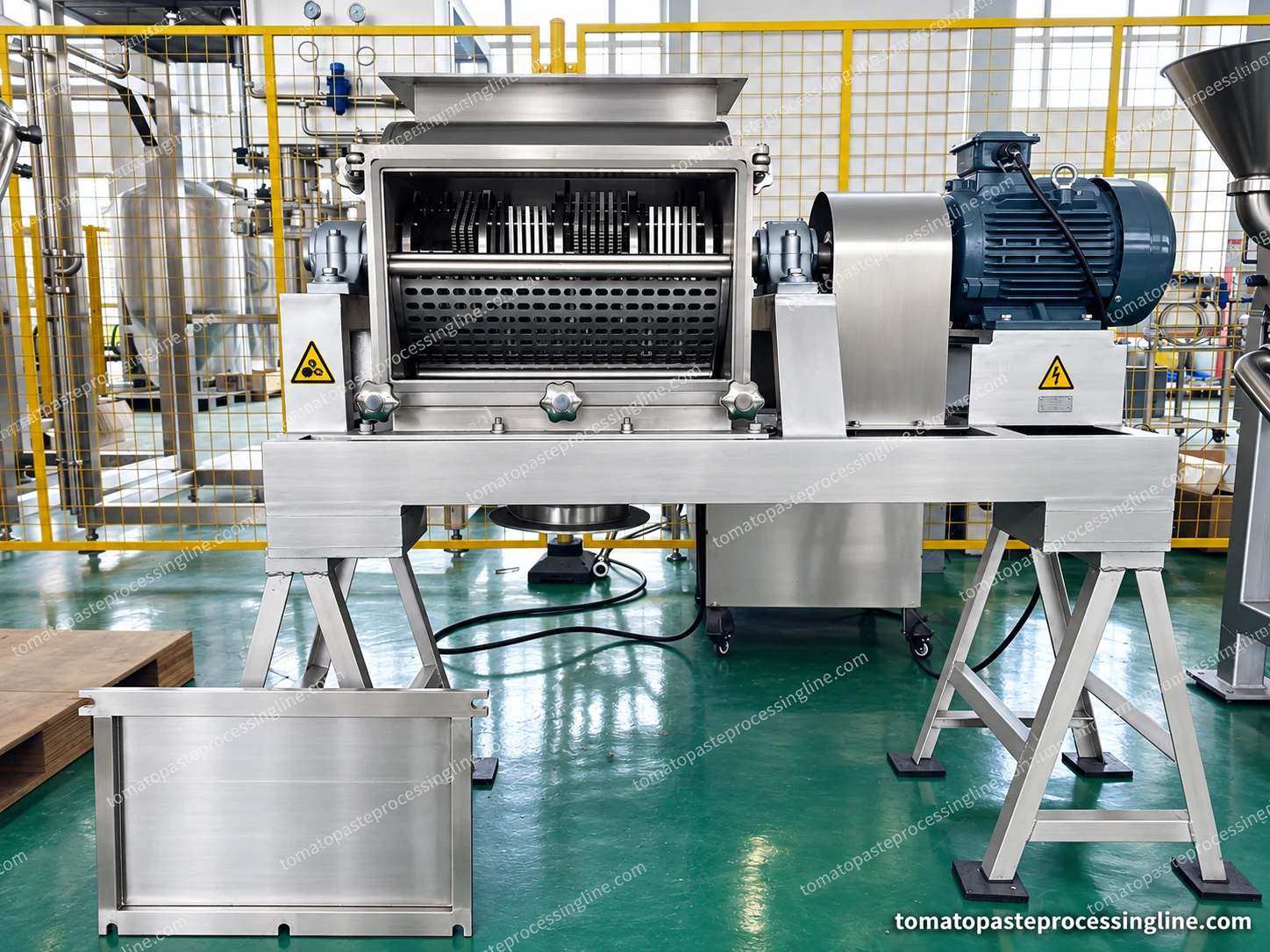
Follow the fruit through the cutting chamber
Fruit enters from the upper hopper and encounters the rotating cutting assembly. The lower basket and outlet form the route for the crushed material to leave the chamber. The size and condition of the feed, cutting arrangement and discharge loading influence the consistency passed downstream.
The open view is a service condition. The chamber must be secured and the selected guarding and isolation procedure followed during operation and maintenance. Plan enough space to remove the cover and inspect the knives, basket and sealing surfaces.
PS family reference table
The table lists general fruit-crusher series references, with a stated rotor-speed reference of 1470 r/min. Tomato duty still depends on fruit condition, selected cutting configuration and the accepted outlet size. The open-view machine is not assigned a specific PS model.
| Series model | Reference fruit rate, t/h | Drive power, kW |
|---|---|---|
| PS-1 | 1 | 2.2 |
| PS-5 | 5 | 5.5 |
| PS-10 | 10 | 11 |
| PS-15 | 15 | 15 |
| PS-25 | 25 | 22 |
Connect crushing promptly to the break step
Crushing releases tissue and starts the sequence that determines later pulp consistency. The route to the preheater should therefore define the elapsed time, transfer capacity and temperature measurement points. An unnecessary hold or irregular feed changes the conditions entering break treatment.
Check the largest particles accepted by the transfer and heating passages. A downstream restriction can cause material to accumulate at the crusher outlet even when the rotor itself has available drive capacity.
Inspect cutting condition before adjusting the process
Worn or damaged knives and a fouled basket can change the crushed feed. Inspect those components and the discharge before compensating with higher loading or other line settings. Include replacement parts and the intended knife/basket arrangement in the equipment documentation.
A representative trial should record whole-fruit feed, the outlet particle condition, temperature and downstream stability. Keep crusher throughput separate from screened puree recovery and finished concentrate output.
Further detail
Questions about this equipment and process
Does this crusher remove skins and seeds?
Its principal task is size reduction. Separating skins and seeds from the accepted pulp is the downstream pulping and refining duty.
Can the PS reference rate be used as the line’s paste output?
No. It describes a general fruit-crusher feed reference. Refining rejects and concentration change the mass flow before paste reaches the filler.