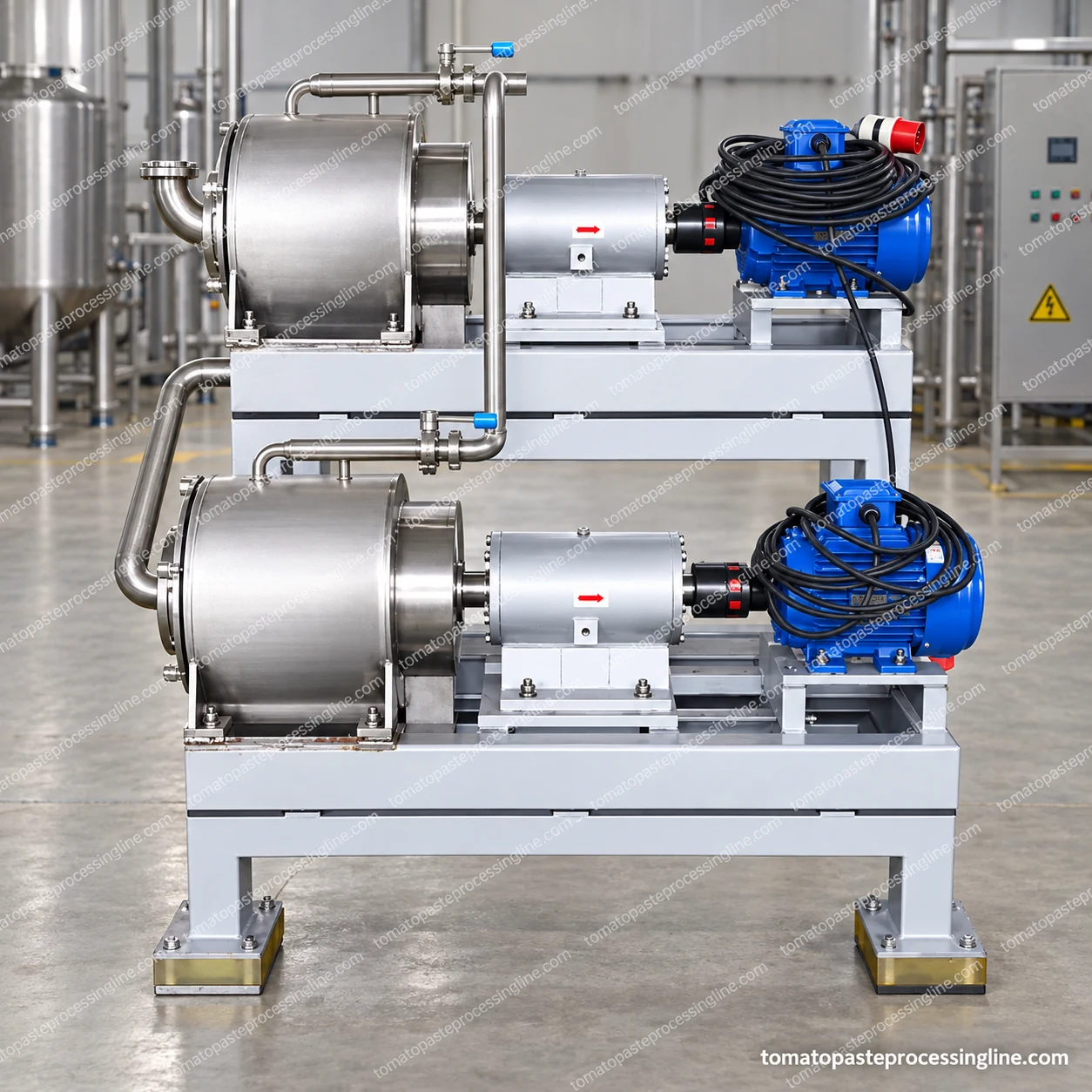
Follow the feed through the rotor and screen
The rotating working elements move prepared tomato material against a perforated screen. Screened pulp passes into the collection path, while coarse residue progresses to its discharge. In a two-stage arrangement, the first separation feeds a finer stage rather than doubling the line’s capacity.
The screen must be selected with the tomato condition and acceptable finished texture in view. A finer opening can change product particles and increase the screening burden. It cannot correct every upstream problem: uneven crushing or unsuitable preheating can still produce variable flow and residue.
Measure pulp and reject together
Product flow, visible skin or seed carryover and texture describe one side of the separation. Reject quantity and wetness describe the other. A sudden change in either can indicate a feed change, screen loading, wear, incorrect assembly or an operating adjustment.
Comparisons are most useful at a similar feed temperature and fruit condition. A wet reject during one trial cannot be interpreted as a fixed recovery loss for every batch. Keep the rejected fruit upstream separate from the pulper residue when preparing a plant balance.
| Observation | First comparison | Why it matters |
|---|---|---|
| Lower pulp flow with wetter residue | Feed condition, screen load and available discharge path | Usable material may be leaving with the coarse stream |
| More coarse particles in the pulp | Screen condition, seating and the selected aperture | Texture may have changed before evaporation |
| Unstable load or surging flow | Crusher supply, temperature and downstream transfer | A fluctuating feed can resemble a screen-capacity problem |
Compare consistency after the same preparation
Paste consistency depends on the particles remaining after finishing, the earlier heat history and the concentration. Measure samples under a consistent method and temperature. Comparing a warm concentrated sample with a cool dilute sample can obscure the effect of the equipment setting.
For a puree preparation section, the specification may focus on coarse-particle control and transfer to an existing process. For a smooth ketchup, later mixing or homogenization may add a different texture treatment. These are distinct operations, so a homogenizer should not be described as the machine that removes tomato skins and seeds.
Leave room for screen removal and inspection
The pulper layout should allow safe access to the processing chamber and withdrawal of the screen. Inspection covers perforations, screen seating, wear surfaces and the separation between product and residue paths. Correct reassembly is part of restoring a repeatable product after cleaning.
Closed downstream lines may be cleaned by CIP while the screen and open contact areas need a different accessible procedure. Cleaning verification should include the areas where fibres, skin and seeds collect, rather than relying only on the appearance of the outgoing rinse.
Further detail
Questions about this equipment and process
Does the smallest screen always give the best product?
No. The desired texture, feed condition, screening load and reject behaviour determine the suitable opening. A finer screen changes the separation duty and can constrain throughput.