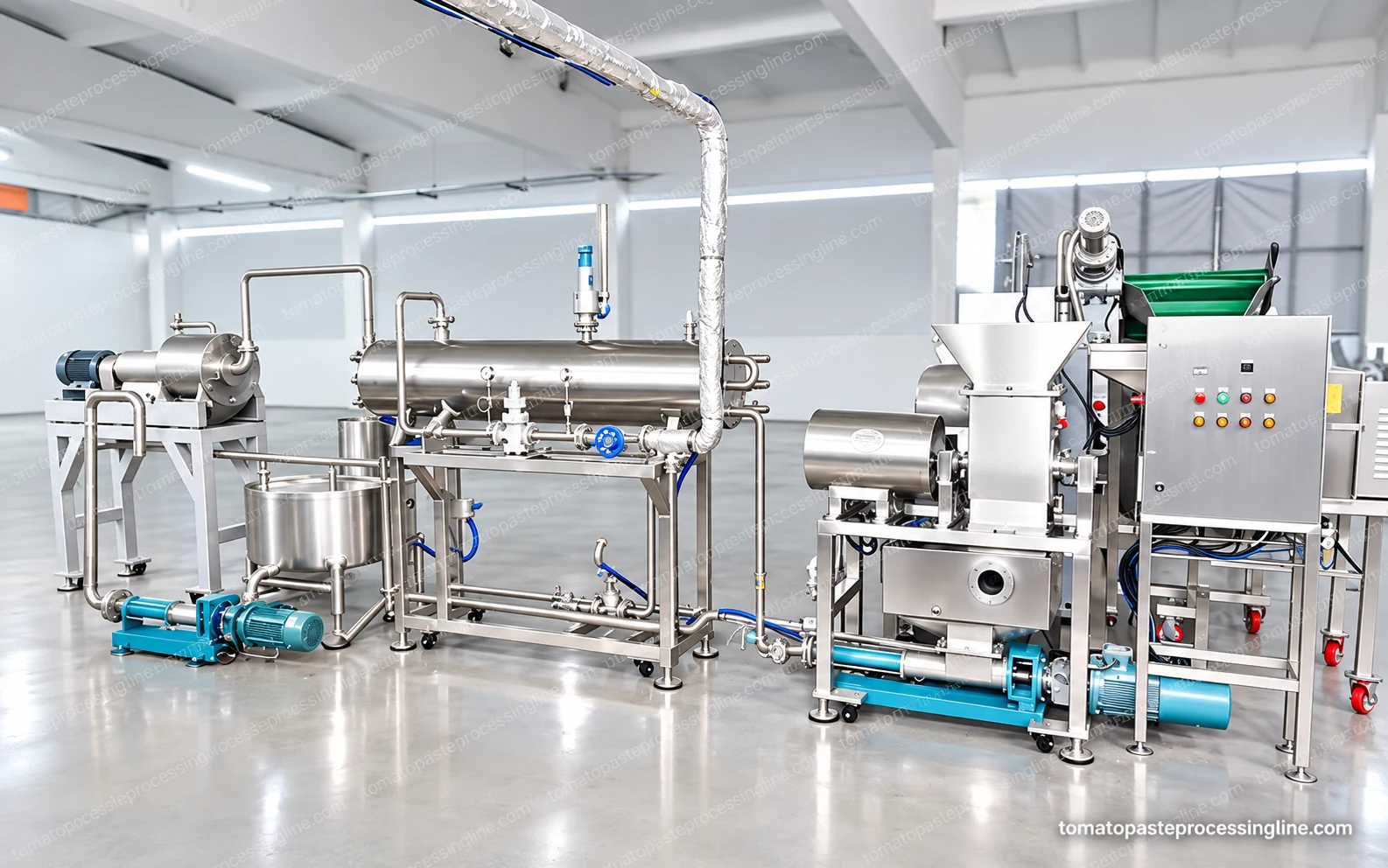
Five operations form the preparation section
The reported supply includes a hammer crusher, an automatic tubular preheating system, a single-stage pulper, screw transfer pumps and a material buffer tank. Together these reduce the incoming material, condition it for pulping, separate a usable puree and deliver it to the next process.
The application is puree preparation for baby-food production. Final blending, final product treatment and packaging sit beyond this reported front-end scope.
A shared section still needs material-specific operation
Tomato, apple and pumpkin have different structures and preparation needs. Feed condition, heating response and screening load therefore matter when the section changes material. An established connection between the machines is useful, but it does not remove the need to set the process for each feed.
The pulper in this reported installation is single-stage. A two-stage pulper and finisher is another configuration for a different separation requirement; it should be selected from the required texture and feed rather than treated as an automatic upgrade.
Buffering makes the downstream handoff explicit
The transfer and buffer arrangement connects puree preparation to the receiving process. The interface describes texture, temperature, flow and acceptable variation. A buffer can accommodate ordinary differences in supply and demand, while level and pump control maintain a usable transfer.
For a new installation, the receiving equipment determines the relevant outlet conditions. This is particularly useful when the project adds a front end to a plant that already has its blending or thermal equipment.
Assess the section by its puree output and accessibility
A preparation trial should describe the material entering the crusher and the puree delivered at the handoff. Screened texture, coarse-particle control and stable transfer are meaningful results alongside the flow measurement.
The arrangement also needs accessible crushing and pulping components, space for screen handling and appropriate cleaning circuits. Those physical details support repeatable operation when material and production schedules change.
Further detail
Questions about this equipment and process
Can the reported 1000 L/h be read as 1 t/h of fresh tomatoes?
No. A volumetric process rate and a fresh-fruit mass rate use different measurement bases. Conversion requires the appropriate material density and a definition of the measurement point.