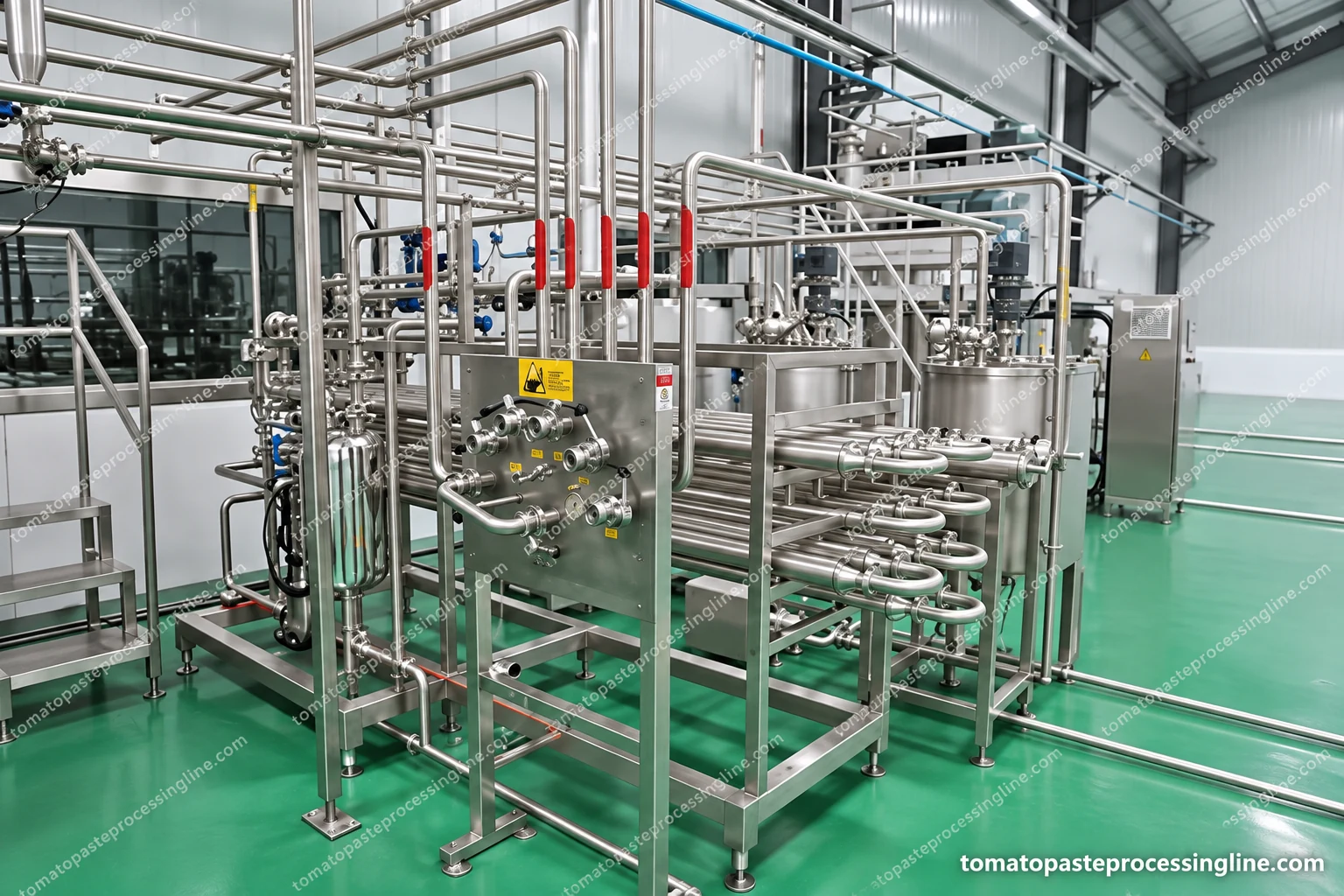
Use conditions at the equipment connection
A supply value measured elsewhere on the site may not describe what reaches the machine during production. Record the available heating service, pressure, temperature and flow at the intended equipment connection, including other consumers operating at the same time.
Break treatment, evaporation and final thermal processing perform different duties. Their service requirements should be stated separately. Do not choose a final heater from the conditions of a preheater or assume that the evaporator and filler can share an unspecified utility allowance.
Treat cooling and vacuum as connected requirements
Evaporation removes water from the product and creates a vapor-handling duty. Condensation and vacuum arrangements depend on the available services and the selected equipment configuration. Cooling-water conditions therefore belong in the evaporator selection, not only in the general plant layout.
Final product cooling has another process purpose and must suit the thermal and package sequence. Ask for the conditions required at each connection and the way service interruptions affect product flow. Avoid relying on a single generic cooling-water quantity for the entire line.
Clarify the site and supplier boundaries
For each machine, identify which service items are included in the equipment package and which must be provided at site. Piping, drainage, access, control interfaces and utility connection positions need to be coordinated with the installation drawings.
Include startup, cleaning and reduced-feed operation when reviewing service availability. A quoted operating point should state its product and utility basis. Without that basis, a claimed consumption number cannot be used reliably to compare proposed configurations.
Further detail
Questions about this equipment and process
Can the same utility number be used for every process section?
No. Preheating, evaporation, final treatment, cooling and cleaning have different duties and should be specified at their own connection conditions.
Why does cooling-water temperature matter to evaporation?
It affects the intended condensation and vacuum arrangement. Include available supply conditions when the evaporator configuration is selected.