Start with soil load and fruit condition
Tomatoes arrive with different amounts of soil, loose debris and damaged fruit. A washing arrangement should be selected for those incoming conditions, including the crop presentation and receiving pattern. A nominal line capacity does not describe the cleaning task on its own.
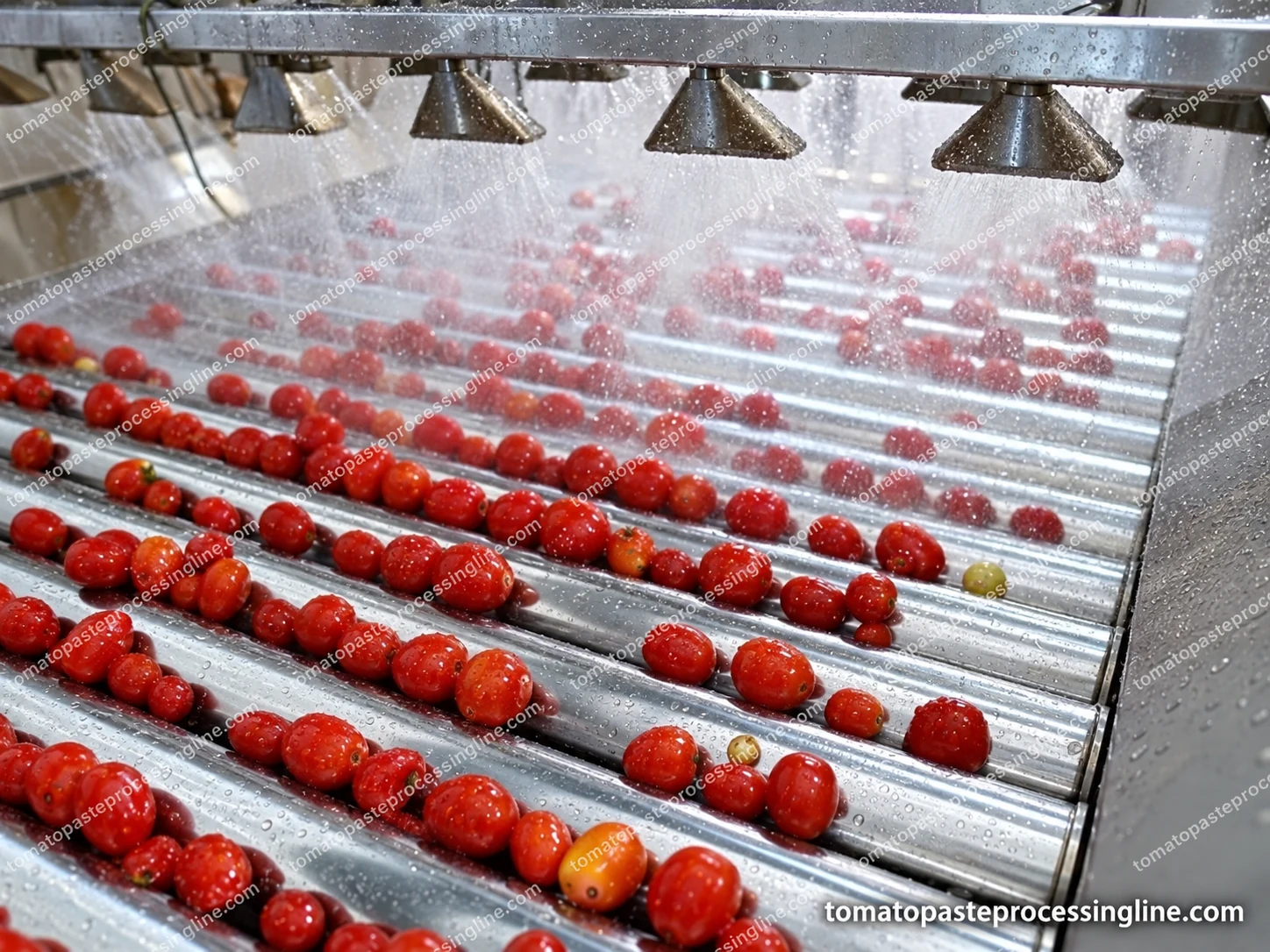
In the illustrated roller washing section, fruit passes beneath spray headers. An even loading layer allows sprays to contact exposed surfaces; fruit stacked in deep piles can shield the lower layer. Coordinate the entry, roller section and downstream inspection rather than increasing spray force by default.
Specify supply, return and drainage separately
State how water is supplied to the sprays, how used water and debris leave the washing area, and whether any return-water route is part of the intended system. These paths should be defined explicitly instead of assuming that a spray section includes a complete water-treatment installation.
Consider nozzle access, drainage beneath the carrying path and the condition of surfaces around the receiving section. Water and tomato tissue should not accumulate where drives or maintenance points need to be reached. The required arrangement depends on the actual loading and cleaning conditions.
Make washing support the inspection duty
A clean, manageable fruit layer helps operators inspect the crop and remove unsuitable material before crushing. Belt or roller speed, lighting, access and reject collection should suit that task. Washing and inspection can become a bottleneck if the receiving peaks are allowed to dictate an uncontrolled feed.
Request an arrangement that shows the transfer points and available space. Include cleaning access to sprays, rollers, return paths and chutes. Open-equipment washing requires its own procedure and should not be treated as a closed-pipe CIP circuit.
Further detail
Questions about this equipment and process
Will higher spray pressure solve poor washing coverage?
Not necessarily. Loading depth, nozzle arrangement, presentation and fruit firmness must be considered together.
Does a washing machine include all water-treatment equipment?
Do not assume so. Specify the supply, return, discharge and treatment boundaries in the requested scope.