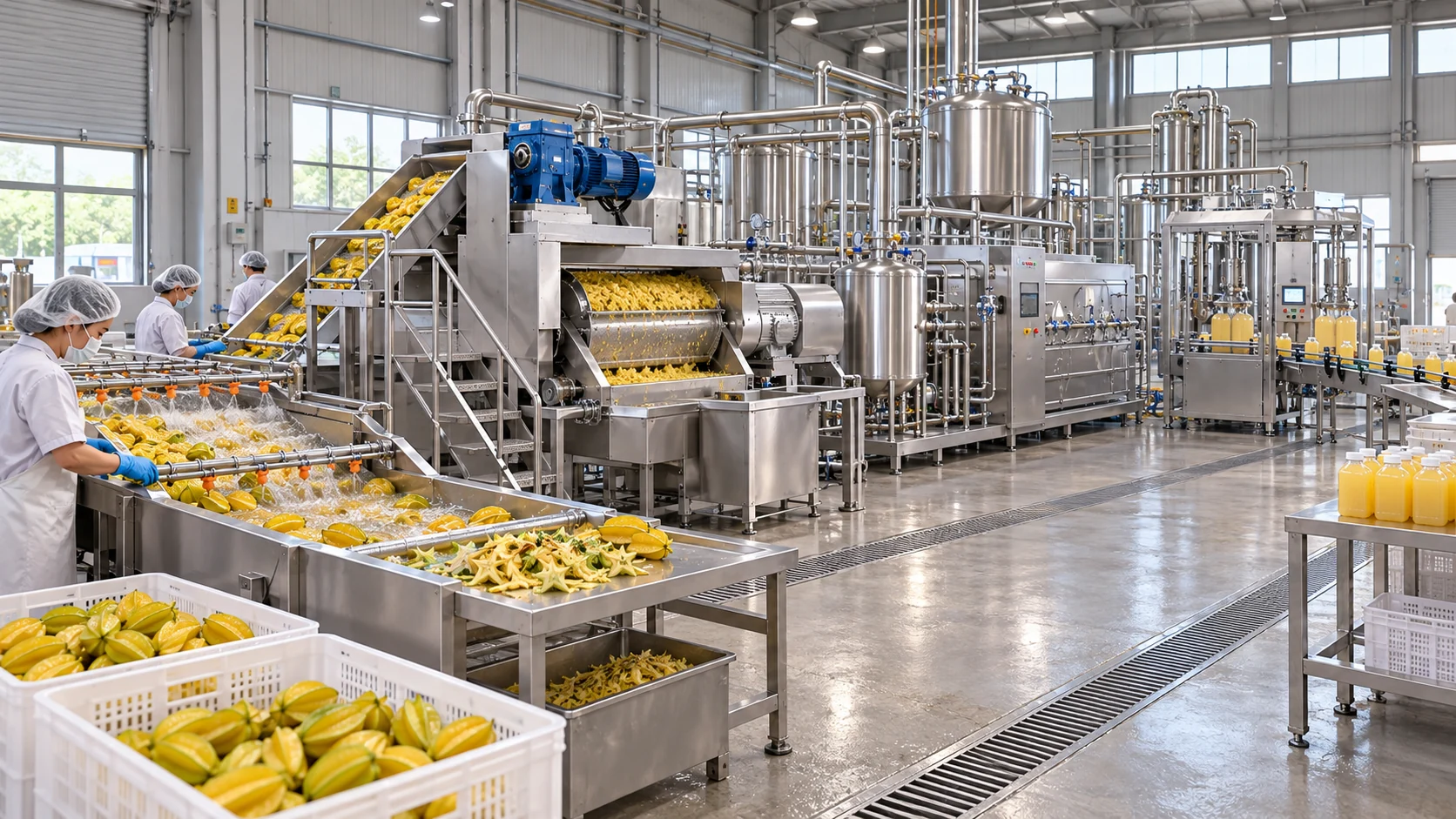
Product routes
- juice
- sweetened beverage base
- blended juice ingredient
Incoming material and preparation
What cultivar and maturity mix will supply the plant, and how much variation in acidity and flavour can the target blend tolerate?
Should the buyer retain a cloudy appearance or require a clearer ingredient, and which ridge fragments, seeds or visible sediment need to be removed during finishing?
Define incoming state, variety, maturity, accepted defects and supply interruptions in the purchasing brief. A proposed line should be demonstrated with representative commercial lots rather than a single ideal sample.
Inspect accepted lots
Record variety, maturity and fruit condition.
The actual ribbed shape and size range should be included in handling trials.
- Equipment duty: Receiving conveyor and inspection table
Clean the surface
Remove debris before cutting and extraction.
Demonstrate cleaning around the fruit ribs rather than relying on a smooth-fruit reference alone.
- Equipment duty: Washer and controlled rinse
Trim and prepare
Remove unwanted parts and prepare a repeatable extraction feed.
State the accepted preparation labour and the condition supplied to the next machine.
- Equipment duty: Inspection/trimming station and controlled cutter
Extract the product fraction
Recover the declared liquid or flesh-containing base.
Keep seed and coarse-skin rejection visible in the assessment.
- Equipment duty: Juice press or pulper selected for the ingredient
Finish the texture
Meet the desired cloud, pulp and mouthfeel.
A smooth blend ingredient and a pulpy fruit base should have separate acceptance criteria.
- Equipment duty: Finishing screen and sample points
Route the accepted ingredient
Connect the prepared base to its selected downstream process.
Any formulation, clarification or concentration is an additional development choice.
- Equipment duty: Covered vessel and suitable transfer pump
Specify preservation around the actual product
Confirm the measured product composition, particulate load and intended storage chain before the treatment and filling arrangement is selected.
The juice or beverage blend base route needs its own validated process. A drawing, a heat-exchanger name or a successful extraction trial does not establish a safe treatment schedule or a finished shelf-life claim.
- Equipment duty: Selected treatment unit, controlled transfer and process instruments
Fill, identify and verify the packed ingredient
Match the approved ingredient to the selected package and handling conditions. Record the production lot and the conditions required by its defined distribution route.
The filling boundary belongs in the project specification: container format, product-contact interface, filling hygiene, storage and the downstream user’s receiving requirements must agree before commercial acceptance.
- Equipment duty: Compatible filler, packaging interface and lot-identification station
Quality checks along the process
Review flavour, acidity, cloud and coarse particles on identified lots. Evaluate the ingredient in its intended blend without making unsupported health or nutrient claims.
Define the sampling location, sample preparation, measurement method and acceptable variation. Retain traceable comparisons through the intended downstream route; a favourable immediate sample is not proof of storage stability.
Equipment modules and selection
| Equipment module | Process role | Selection basis |
|---|---|---|
| Receiving conveyor and inspection table | Control the incoming-material presentation before preparation. | Check actual lot condition, peak arrivals and the accepted size range. Provide a sample/reject point that can be operated without obstructing feed to the next machine. |
| Inspection/trimming station and controlled cutter | Preparation and extraction. | A trial should distinguish the edible fraction entering extraction from whole-fruit weight. The agreed pulp or seed character determines how much separation follows the initial extraction. |
| Juice press or pulper selected for the ingredient | Create the agreed intermediate condition for downstream equipment. | Agree an acceptance sample, a measurable particle or separation target and a reject-handling method. Select contact parts and access arrangements after trials with representative material. |
| Product buffer and transfer system | Connect preparation, treatment and filling without assuming all sections run at the same rate. | Record viscosity, particle character, temperature envelope and expected stoppages. Confirm drainability, sampling points and how unaccepted or interrupted product is identified and handled. |
| Preservation, packaging and cleaning interfaces | Complete the declared process boundary. | The quoted scope should identify included instruments, services, containers, hygienic connections and validation responsibilities. An item list without these interfaces is not a complete line specification. |
Packaging and storage interfaces
Specify whether the juice or beverage blend base is supplied as a chilled, frozen, otherwise treated or aseptically handled ingredient, as applicable to the developed product. Package material, closure, fill conditions and distribution are a connected system. Any claimed ambient stability or shelf life requires product- and package-specific validation; the process introduction does not set treatment temperatures or holding times.
Product and residue streams
Segregate trimming rejects, seeds and coarse solids. Do not count a secondary extraction fraction as accepted product without its own quality decision.
Cleaning circuits and physical access
Inspect cutter, rib-cleaning contact areas and screens for retained solids. Open preparation and the closed product circuit require distinct cleaning responsibilities.
Assign cleaning responsibilities to the open preparation zone and the closed product circuit separately. Confirm which parts require removal or inspection and how cleaning effectiveness will be demonstrated with the actual product soil.
Inputs for the engineering brief
- Trial the accepted fruit shape and maturity range, assessing the prepared ingredient in the intended final application.
- Provide the intended finished-product specification, representative raw-material samples, daily operating pattern and seasonal peak load.
- Identify available utilities, factory layout, drainage, reject collection and the exact inlet/outlet conditions of equipment supplied by others.
- Agree trial acceptance criteria and define the preservation, filling, cleaning and commissioning responsibilities before finalising the equipment scope.
Compare the preparation and concentration basis
A fresh-tomato paste line connects receiving and break treatment with skin/seed separation and a specified concentration duty. Other fruit and vegetable products can need different preparation and texture controls, and a concentrate is not simply any puree put through an evaporator.
Compare the tomato pulp-finishing and evaporation duties below with the product stream described on this page. The raw-material specification, solids measurement, viscosity and preservation/package interface must define the actual configuration.
Sources and processing scope
The references support these material and processing considerations. The actual equipment, process conditions, preservation method and packaging interface follow the specified raw material and finished product.
Further detail
Questions about this equipment and process
Can a round-fruit washer be assumed adequate?
The actual starfruit ribs and accepted size range should be demonstrated. Equipment selection should follow cleaning and transfer results on the intended supply, not only a broad fruit category.
Does a juice route establish a finished beverage?
No. A beverage adds a formulation, preservation, package and storage specification. The prepared starfruit ingredient is only one defined input to that project.
What should a useful starfruit / carambola trial establish?
Trial the accepted fruit shape and maturity range, assessing the prepared ingredient in the intended final application. Record incoming material, accepted feed, finished ingredient and each reject stream separately. Keep settings, samples and analytical methods with the trial record so the result can be compared with subsequent seasonal lots.