Record the break-stage intent, not just a setpoint
Break treatment is selected for the texture and enzyme behaviour the product needs. The existing guide on hot break and cold break explains that choice, so this article does not repeat it. What a trial record needs is the intent: which break condition was being sought, what product flow and hold arrangement were used, and whether the run stayed within the intended window.
Record the start and end of the break stage, the product condition entering it and any interruption. A setpoint on a screen is not evidence that the product received the intended treatment. The break stage is also not the final preservation step; treating it as one can hide the separate thermal duty that follows concentration.
Trace pulp through concentration
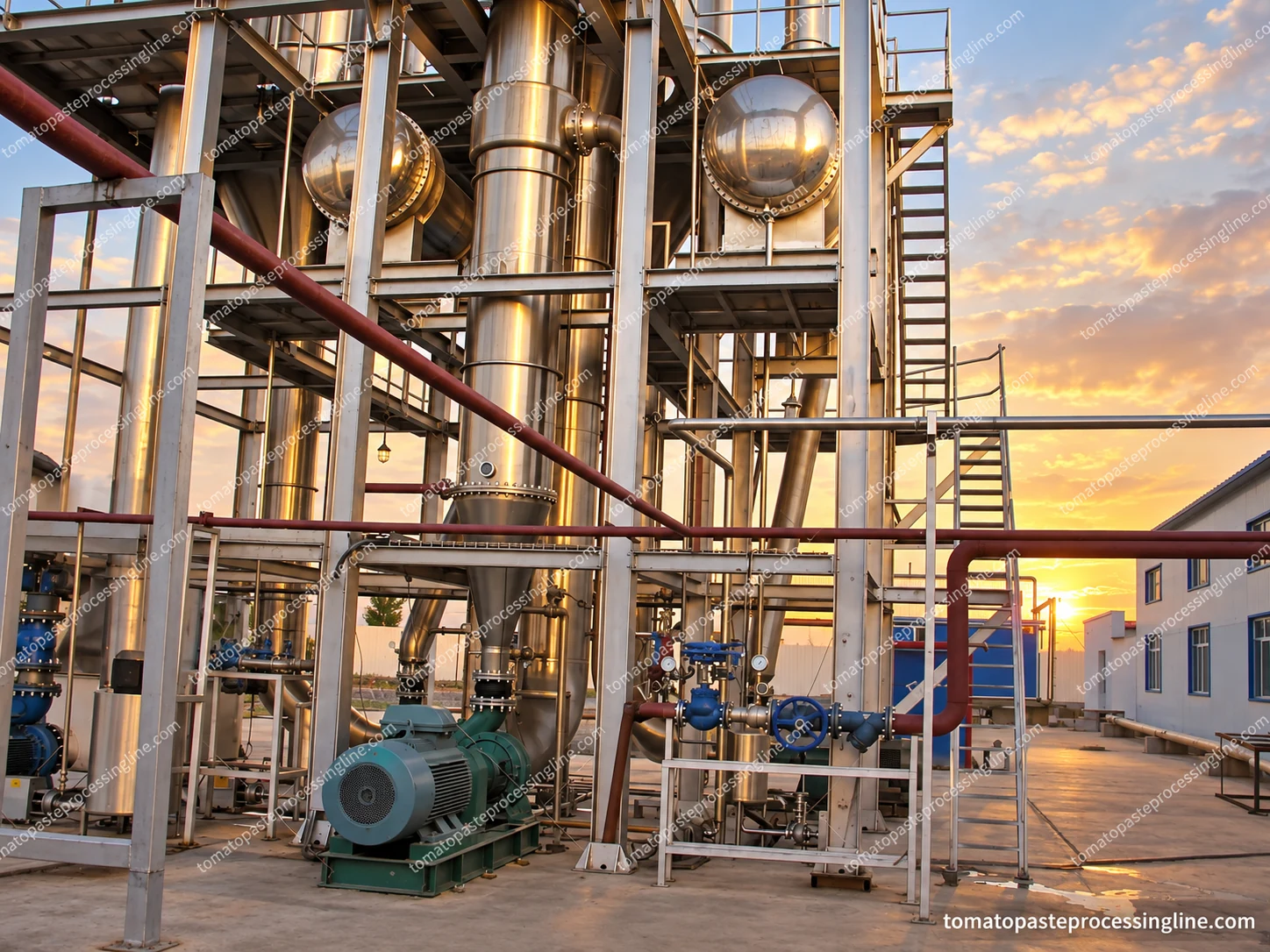
Concentration changes the material that later equipment must handle. Record inlet and outlet flow, soluble solids, product temperature and the vacuum or heating conditions that were actually observed. Distinguish measured water removal from a calculated value, and note the sample basis used at each end. The same outlet solids can be reached with different residence and circulation histories.
The Tetra Pak Dairy Processing Handbook describes evaporation as water removal under vacuum and notes that product viscosity and heat stability limit how far concentration can be pushed. It also explains that multiple effects trade steam economy against residence time and temperature profile. Those are equipment principles, not tomato settings; do not copy dairy temperatures or steam figures into a tomato trial record.
Record the sample points on the same diagram as the equipment. A reading taken at the evaporator outlet, after a transfer pump or after a holding vessel may have a different temperature and shear history even when the solids are similar. If the trial relies on a calculated concentration factor, state the calculation and the measured inputs. If it relies on a laboratory result, state the method and the sample handling time.
Compare consistency under common conditions
Consistency is not a single number that can be compared across laboratories without a method. If two trials are being compared, measure at the same product point, at a stated temperature and with the same instrument or descriptive scale. Record any finishing, homogenization or transfer that occurs after evaporation, because texture can change after the evaporator outlet.
The FAO tomato pulp flow sheet places extraction and screening before concentration, and the physical condition of that pulp affects what the evaporator receives. A trial that changes the screen, the break condition and the evaporator together cannot isolate the effect of any one of them. Hold the variables that are not under test, or state clearly that the comparison is a combined process change.
Preserve treatment and transfer timestamps
Record every transfer between break treatment, buffer, evaporator, final thermal treatment and filling. Include holding time, product temperature where measured, and the line state during startup, shutdown, recirculation or a packaging interruption. Product that is recirculated or held during a stop accumulates a different history from product that moves straight through.
Use one time basis across the line and note who recorded each event. If clocks differ, say so rather than silently aligning them. A heat history is only useful when it can be read alongside the lot record, the equipment state and the sample identity. The final thermal step is separate from break treatment, and both belong in the same timeline.
Include the state of the line at each timestamp: running, recirculating, stopped, cleaning or waiting for packaging. A temperature that looks stable on a chart can represent a different product residence time if the line was recirculating. Write down the unusual events as well as the planned ones; they are often the explanation a later reviewer needs.
Turn the heat history into a trial record
A workable trial record states the question, the fixed inputs, the variables being changed, the samples taken and the acceptance criteria. It also records deviations, because a deviation often explains an unexpected result better than an average does. Keep the record tied to the actual lot and the actual equipment configuration.
The output is evidence for the next decision, not a universal process guarantee. A tomato paste trial that can show its full heat history is easier to repeat, easier to challenge and easier to connect to a product specification. That is a more useful result than a single impressive number.
Sources
Primary documents used for this analysis. Read the named section in context before applying it to a project.
- FAO Fruit and vegetable processing, Appendix I: tomato pulp flow sheetFood and Agriculture Organization
- Tetra Pak Dairy Processing Handbook, Chapter 7.6: EvaporatorsTetra Pak
Source links are provided for verification. Inclusion does not imply endorsement of this site or of any equipment configuration.
Discuss this topic
Connect the note to your own line brief.
Share the incoming material, the product identity you need and the packaging boundary. We can help frame the equipment scope without pretending that an article replaces a trial or a food-safety review.