Identify the harvest lot and its transport history
A useful lot record begins before the first tomato reaches the washer. Record the supplier or growing block, the harvest window, the delivery time and the container or trailer used. If the fruit was held before delivery, note the holding condition and duration. These facts do not prove quality, but they give the receiving team a way to compare deliveries on more than appearance.
The FAO technical manual on small-scale fruit and vegetable processing treats raw-material quality as a determinant of the processed product and notes that harvest and post-harvest handling influence that quality. For a paste plant, the practical translation is simple: a delivery is not only a mass of red fruit. It is a specific lot with a handling history that may explain variation in solids, firmness, defects and the pulp that follows.
Assess sound fruit and defects before the crusher
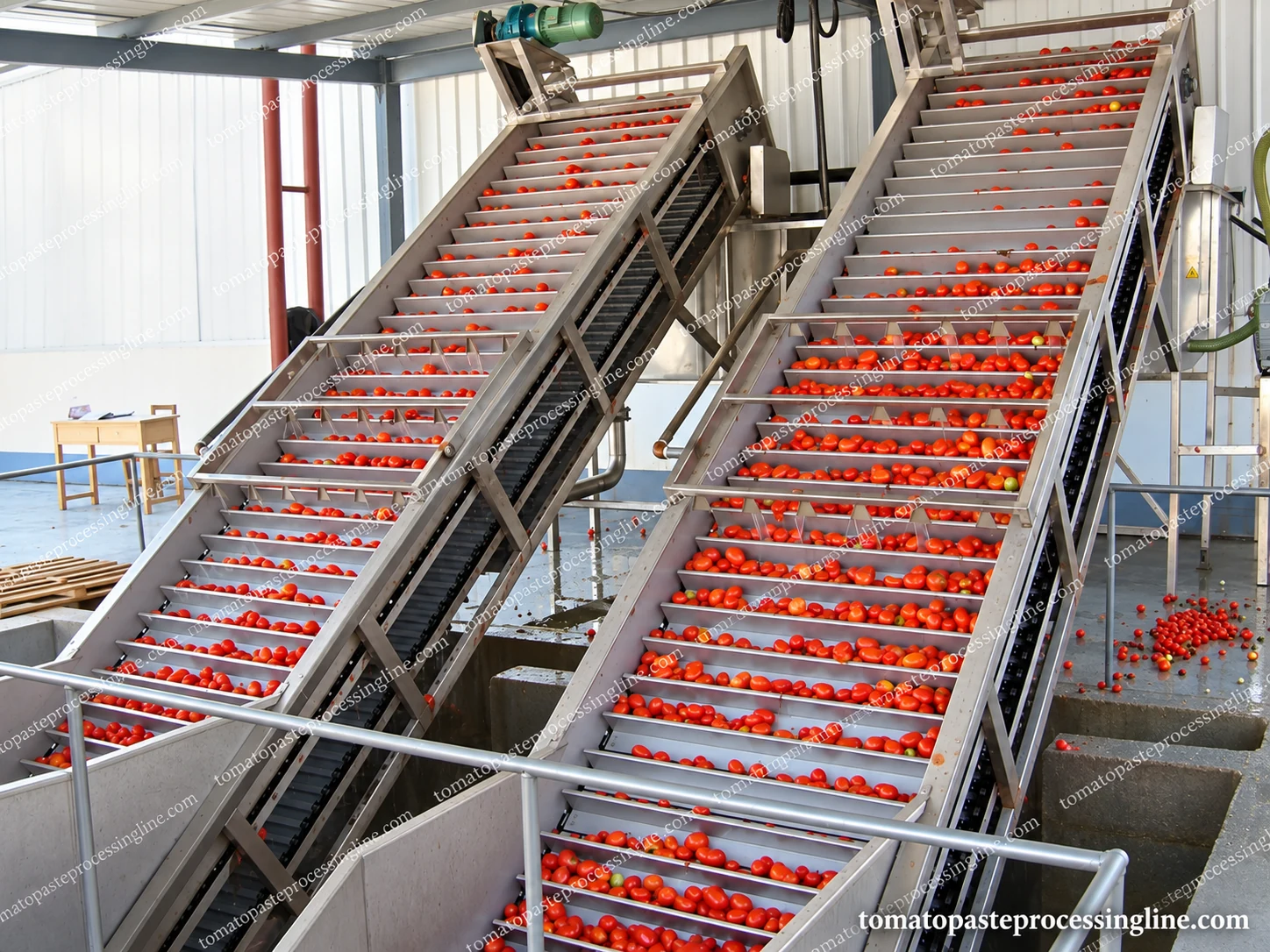
The FAO tomato pulp flow sheet places washing, draining, sorting and halving before extraction, with sorting used to find disease or decay inside the fruit. That sequence is a useful reminder that surface colour cannot reveal every defect. Mould, insect damage, overripe tissue and foreign material can all reach the crusher if inspection is treated as a decorative belt rather than a decision point.
Define the defect classes that matter for your product and record their disposition: accepted, trimmed, rejected or diverted. Keep field soil and foreign material separate from fruit defects so that the record shows what the washer and inspection station actually removed. The record should also show the reject mass or count and the reason, because a large reject stream changes the mass available to pulping even when the delivery weight looks normal.
Sample solids on a defined basis
°Brix is a refractometric indicator of soluble solids, not a complete measurement of every solid in the fruit. A reading taken from whole fruit, crushed mash, screened pulp or finished paste describes a different material. State the sample point, the sample preparation, the instrument and the temperature or correction used. Without that basis, two numbers that look comparable may not be.
The FAO manual describes sampling and analysis regulations as part of an integral quality-control programme and identifies soluble solids among the chemical parameters to measure. For receiving, take a representative sample rather than one attractive fruit, record the range as well as the average, and link the result to the lot identifier. Use the same basis later when the lot is compared with prepared pulp and evaporator feed.
Connect accepted mass to prepared pulp
Weigh the accepted fruit, the reject streams and the prepared pulp. These measurements let the plant close a simple mass balance around receiving, washing, crushing and screening. The balance will not be perfect because water, trimmings, retained product and sampling all intervene, but an unexplained gap is more useful than a polished number that nobody can trace.
Carry the lot identifier through the preparation steps and into the buffer or evaporator feed. That link allows a later texture or concentration difference to be examined against the fruit that produced it. It also prevents a familiar mistake: attributing every change in pulp behaviour to the pulper when the incoming lot, holding time or defect load has changed. A lot record is a diagnostic aid, not a yield guarantee.
Put the record to work in the trial
When trials are compared, read the receiving record first. If two runs used different lots, holding conditions or defect levels, the equipment was not the only variable. Record the decisions taken at receiving and any deviation from the normal acceptance rule. That context is more valuable than a page of observations with no material history.
Keep the record short enough to be completed during a busy harvest and specific enough to answer a later question. A delivery reference, harvest window, defect disposition, solids sample basis, accepted mass and pulp link are a practical minimum. The aim is not paperwork for its own sake; it is a chain of evidence from the fruit gate to the process trial.
Sources
Primary documents used for this analysis. Read the named section in context before applying it to a project.
- FAO Technical manual on small-scale processing of fruits and vegetables, Chapter 4: Raw materialFood and Agriculture Organization
- FAO Technical manual, Chapter 6: Quality control and samplingFood and Agriculture Organization
- FAO Fruit and vegetable processing, Appendix I: tomato pulp flow sheetFood and Agriculture Organization
Source links are provided for verification. Inclusion does not imply endorsement of this site or of any equipment configuration.
Discuss this topic
Connect the note to your own line brief.
Share the incoming material, the product identity you need and the packaging boundary. We can help frame the equipment scope without pretending that an article replaces a trial or a food-safety review.