Start the equipment balance after skin and seed separation
An evaporator duty belongs at the actual equipment inlet. Whole-fruit intake includes material that may leave during sorting and pulping.
The existing capacity-planning calculator is a no-loss whole-fruit comparison. It preserves the entered soluble-solids proxy and excludes rejects. Its water figure must not be relabelled an achieved or quoted evaporator rate.
Connect the product balance to services and operating cases
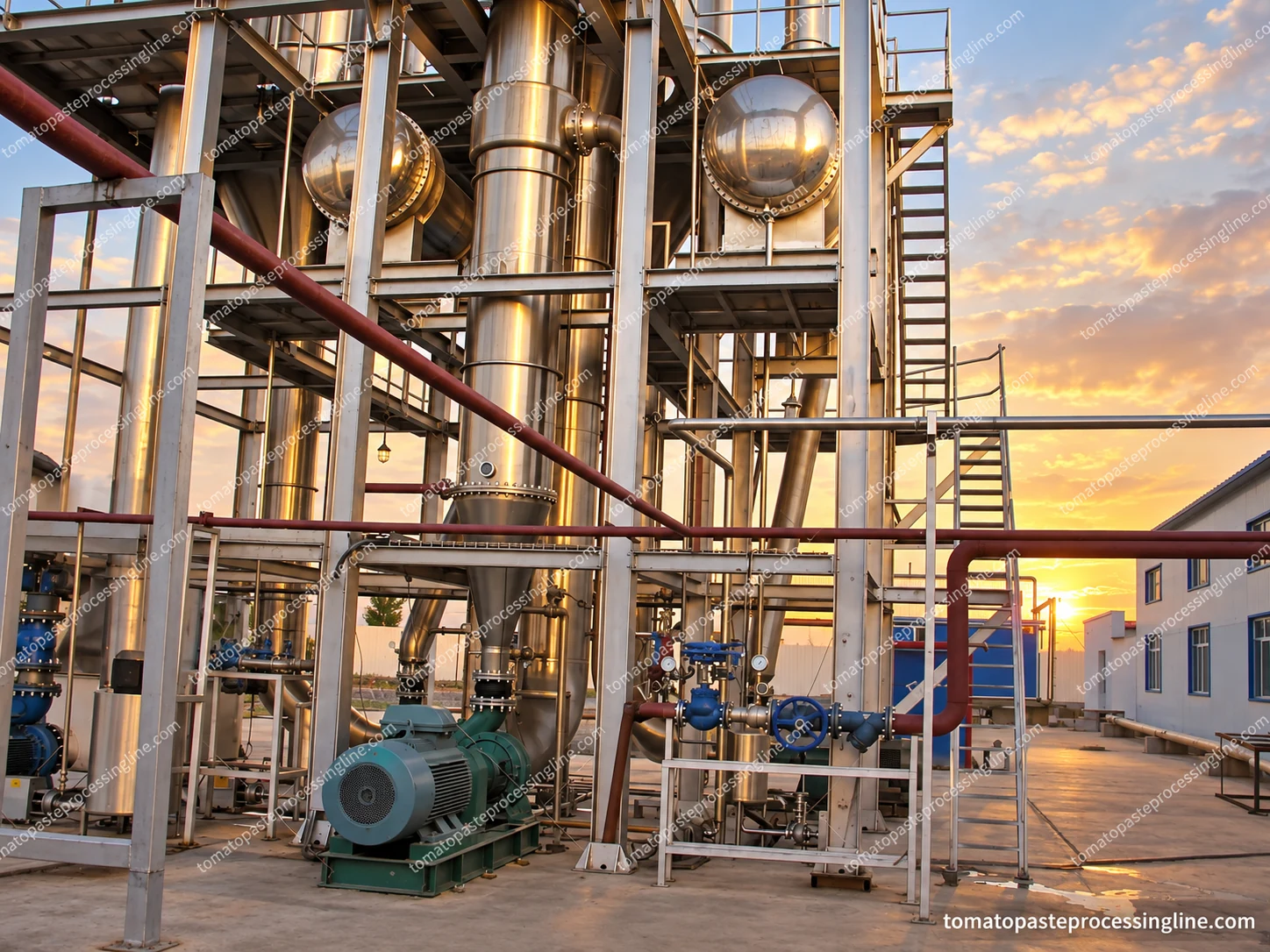
Target paste solids alone cannot define the heating surface or circulation arrangement. Product viscosity, fouling behaviour, available heating and cooling services, vacuum conditions and the operating window belong with the flow data. The equipment image does not establish effect count, evaporation rate or steam consumption.
| Duty item | Project information |
|---|---|
| Refined inlet and paste outlet | Flow, solids method, temperature and product consistency |
| Material accounting | Rejects before the inlet, additions, samples, losses and inventory changes |
| Utilities and boundaries | Heating, cooling, vacuum, condensate, cleaning supply/return and connection ownership |
| Operating envelope | Startup, reduced feed, intended run period, cleaning and downstream stops |
Use one calculation and carry its assumptions into the discussion
The capacity-planning page provides the existing ideal arithmetic and can carry your own inputs and assumptions into an equipment enquiry. For a real evaporator proposal, replace the whole-fruit illustration with the measured inlet balance and agreed product data. A public worked example is not a guarantee of saleable tomato yield.
The proposal should identify the supplied concentration package, upstream buffer and transfer, concentrate discharge and downstream thermal or packaging interface. Test conditions and acceptance measurements remain to be agreed for that package.